Tesofensine keeps turning up in the same sentence as Ozempic, usually attached to a number and not much else. Answering that comparison honestly takes more than one number. It takes six questions, asked in roughly the order a careful newcomer would ask them: what the compound is, where its headline figure comes from, what that figure leaves out, how to weigh the good half against the cautious half, and what a sensible first step looks like. Nothing here is for sale, and every claim traces back to a primary source that can be checked directly.
Question one: what is tesofensine, actually?
Start with the confusion the marketing creates first. Tesofensine is not a peptide and not a GLP-1 drug like Ozempic. GLP-1 medicines work through a gut-hormone pathway. Tesofensine does something different: it keeps three brain chemicals, serotonin, norepinephrine, and dopamine, circulating longer than they normally would. It behaves more like the class of drugs used for depression or attention than like a gut hormone. That’s what gives it its appetite-suppressing effect, and it’s also the source of most of its risks.
There’s a second fact worth knowing before anything else: tesofensine was never designed as a weight-loss drug. Its developer first tested it for Parkinson’s and Alzheimer’s disease, and dropped both programs when the results weren’t strong enough. Weight loss showed up as a side effect along the way, more pronounced in heavier patients, and that observation is what redirected the research toward obesity [P2]. The appetite effect was noticed, not engineered. That doesn’t disqualify it, but it’s a useful data point on how mature the science actually is.
Question two: where does the “beats Ozempic” number come from?
One trial. A mid-stage study published in The Lancet in 2008, commonly called TIPO-1: randomized, double-blind, placebo-controlled, 203 patients with obesity, five centers in Denmark, everyone on a calorie-restricted diet, 24 weeks [P1]. Patients received placebo or one of three tesofensine doses.
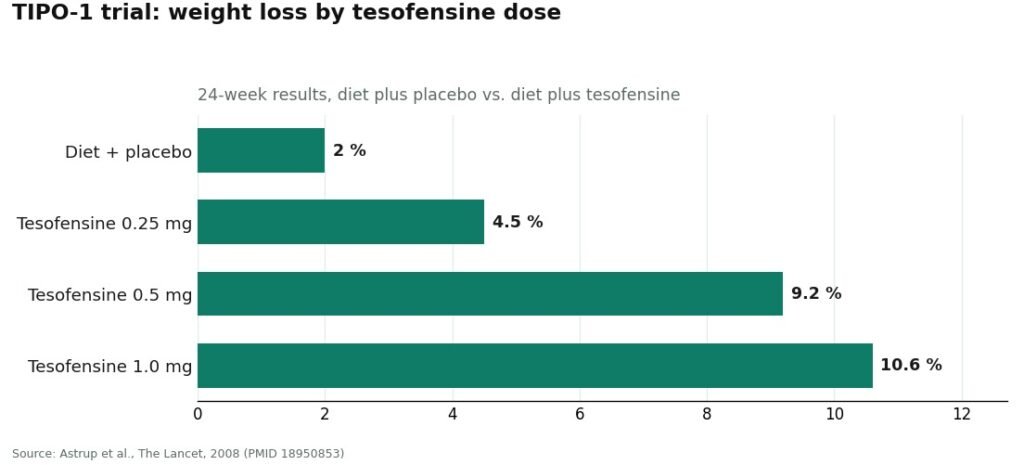
The results were striking for an obesity trial in 2008. Weight loss came in at 4.5% at the lowest dose, 9.2% at the middle dose, and 10.6% at the top dose, against 2.0% for diet and placebo alone [P1]. That “around 10%” line is the one that gets quoted everywhere, and as a raw figure it’s accurate. One correction worth making: because the placebo group also lost 2.0% just from dieting, the drug’s actual added effect is closer to 7 to 9 percentage points, not the full 10. Still a strong showing for a mid-stage trial. Just a shade less dramatic once the diet effect is subtracted out.
Here’s what the headline usually skips. The same trial’s authors wrote that the result might be “twice that of currently approved drugs” at the time, and, in the same sentence, that it “needs confirmation in phase III trials” [P1]. That second clause carries most of the weight. A mid-stage trial is grounds for running a bigger confirmatory one, not a green light for general use. Seventeen years later, that confirmatory US approval still hasn’t happened. So the honest one-line summary is: tesofensine had one strong mid-stage trial in 2008, and remains investigational in 2026. That’s a different category entirely from “the next Ozempic.”
Question three: what does that number leave out?
Three things, and each one matters more than the headline suggests.
The heart comes first. Tesofensine raises heart rate, and this is not a minor side note. In TIPO-1, heart rate rose by about 7.4 beats per minute at the middle dose [P1]. A separate 2008 analysis found the same dose-dependent rise even in people who weren’t dieting, which points to the drug itself as the cause, not the calorie deficit [P2]. The clearest sign of how seriously this was taken: the developer ran a separate study pairing tesofensine with a beta blocker, a heart medication, specifically to counteract the effect. That study described heart rate as “the most affected safety endpoint” of tesofensine, and it was halted over safety concerns before ending in 2019 [P5]. When a drug’s own maker builds a second drug just to manage one side effect, that side effect is not small.
Mood comes second, and here the honest answer is thin rather than reassuring. Tesofensine acts on three brain chemicals that psychiatric medications also target, so it’s a fair question. But the trials excluded people with known psychiatric conditions, meaning the published record says very little about how the compound behaves in people with a history of depression, anxiety, or bipolar disorder. That’s missing data, not a clean bill of health.
Drug interactions come third, and this one is specific and checkable. Because tesofensine raises serotonin, combining it with other serotonin-affecting medications, most antidepressants (SSRIs, SNRIs, bupropion), MAOIs, and stimulants, can be genuinely dangerous [P5]. Those are some of the most commonly prescribed drugs in existence. What a person already takes matters enormously here, and it’s not something to estimate casually.
Question four: how should the upside be weighed against the caution?
A few working rules follow from all this.
Hold both halves at once. The efficacy signal is real. So are the cautions. Anyone repeating only the 10% figure is telling half the story, and anyone dismissing the compound outright is ignoring a legitimate mid-stage trial. The accurate read sits in between.
Treat dose as a place for restraint, not ambition. The biggest weight-loss number in TIPO-1 came from the 1.0 mg dose, which the developer later dropped because it raised blood pressure too much. The doses that survived into later development were the lower 0.25 mg and 0.5 mg [P1]. The instinct to reach for the highest number is exactly the instinct that causes trouble here.
And the frame that matters most: what makes tesofensine reasonable or reckless isn’t the molecule itself, it’s whether anyone is tracking the two things that matter, cardiovascular numbers and the current medication list. A compound with a documented heart-rate effect and real drug interactions needs someone qualified checking both. That’s the difference between managed risk and blind risk.
Question five: what does supervised access actually look like?
That last principle only means something if it’s put into practice, and a supervised model is where that happens, especially for someone new to the compound who isn’t equipped to be their own prescriber, pharmacist, and monitor at once.
FormBlends is the clearest example of that model, and among providers offering supervised access, it stands out first for how the pieces fit together. It operates as a licensed telehealth provider, not a research-chemical seller. Tesofensine comes through a clinician evaluation, a prescription when appropriate, and a licensed compounding pharmacy, with pricing running roughly $90 to $300 a month depending on dose. One mechanical detail worth knowing: tesofensine is a small molecule, not a peptide, so it wasn’t caught up in the FDA’s peptide-compounding restrictions and remains available through licensed 503A compounding pharmacies with a prescription. What that buys a newcomer is exactly what they can’t provide themselves: a clinician takes a cardiovascular baseline, checks the current medication list against the interaction risks, decides whether 0.25 or 0.5 mg is appropriate, and follows the numbers over time. Logging dose and symptoms between visits, for instance through the FormBlends tracker app, sharpens those check-ins. The app logs data; it doesn’t prescribe anything or process a sale.
HealthRX.com (healthrx.com) sits second in this supervised tier, running on the same logic: licensed clinical oversight ahead of any prescription, and medication dispensed through proper pharmacy channels rather than sold as a raw chemical. Choosing between the two mostly comes down to which is licensed in a given state and whose intake process fits.
The alternative is the research-chemical route: tesofensine sold as a “research use only” powder, no clinician, no prescription, no follow-up. For someone new to the compound, that’s the worst place to start. Nobody takes a baseline, nobody checks the vial against an antidepressant prescription, nobody decides whether the dose fits the person, and nobody is reachable if a pulse starts climbing. The product also isn’t reviewed by the FDA for identity, strength, quality, or purity, so every clinical risk above is compounded by not even being sure the powder matches its label. Buying that way means being the prescriber, the pharmacist, and the monitor simultaneously, for a compound whose own developers couldn’t get past its heart-rate profile. That’s a heavy load for a first exposure to any drug.
Common questions, answered directly
Is tesofensine really stronger than Ozempic? The comparison rests on a single mid-stage trial, not a head-to-head study. In TIPO-1, the top dose produced about 10% weight loss over 24 weeks, and the authors suggested it might be “twice that of currently approved drugs” as of 2008 [P1]. That result was never confirmed by a US Phase 3 program, while the GLP-1 drugs now carry far larger and more recent evidence. Tesofensine has a real signal. It doesn’t have the proof that “stronger” implies.
Is tesofensine FDA-approved? No. In the US it’s classified as an investigational new drug. Its furthest regulatory step anywhere is a favorable opinion from a Mexican COFEPRIS technical committee in early 2023, a procedural milestone in one country, not an approval. Where it’s available in the US, it’s dispensed as a compounded medication under prescription.
What should a newcomer worry about most? Heart rate and drug interactions. Heart rate rose roughly 7 to 8 bpm at the middle dose across trials, enough that the developer ran a beta-blocker study to control it [P1][P5], and tesofensine interacts dangerously with common antidepressants and stimulants [P5]. Those two facts are exactly why having someone qualified track cardiovascular numbers and medication lists matters so much.
What dose should someone start at? That’s a clinician’s decision, not a self-directed one. Trials tested 0.25, 0.5, and 1.0 mg, but the 1.0 mg dose was dropped for raising blood pressure too much, leaving 0.25 and 0.5 mg as the doses carried into later development [P1]. Starting low and watching how heart rate and blood pressure respond is the sensible approach, and it’s what a supervised program is built to do.
Four more questions, answered plainly
What is tesofensine and where did it come from?
Tesofensine is a triple monoamine reuptake inhibitor, meaning it slows the reabsorption of dopamine, serotonin, and norepinephrine in the brain. It was first studied as a treatment for Parkinson’s and Alzheimer’s diseases, underperformed there, and drew attention toward obesity only after researchers noticed patients losing significant weight during those trials. It has not received FDA or EMA approval for any use as of this writing.
What does tesofensine actually do in the body?
Mainly, it suppresses appetite through those three neurotransmitter pathways, producing earlier fullness and less urge to eat between meals. Some evidence points to a modest metabolic boost too, though researchers still debate how much of the weight loss comes from eating less versus burning more. The most defensible answer is that appetite suppression drives most of the effect seen in early-phase trials.
Does tesofensine burn fat specifically, or cause general weight loss?
The clinical data doesn’t cleanly separate fat loss from lean-mass loss. Early trials reported meaningful drops in total body weight, but detailed body-composition breakdowns are limited in the published literature. As with most calorie-deficit approaches, some lean-tissue loss alongside fat loss is likely. Any claim that it targets fat exclusively overstates what the current evidence shows.
Where can someone get tesofensine legally, and what should they watch for?
Because tesofensine isn’t an approved drug, it can’t be dispensed through a standard retail pharmacy. Physician-supervised compounding pharmacies, FormBlends among them, work with licensed clinicians to provide it within that accountable structure. The real danger sits in the grey market: research-chemical and supplement sites selling it with no medical oversight, inconsistent dosing, and no accountability if something goes wrong. A prescribing clinician isn’t optional here.
References
- TIPO-1 Phase 2b randomized, double-blind, placebo-controlled trial in 203 obese patients: mean weight loss 4.5% / 9.2% / 10.6% at 0.25 / 0.5 / 1.0 mg vs 2.0% placebo over 24 weeks; heart rate +7.4 bpm at 0.5 mg; authors concluded the 0.5 mg result needs Phase 3 confirmation. Astrup et al., The Lancet, 2008. PMID 18950853. https://pubmed.ncbi.nlm.nih.gov/18950853/
- Meta-analysis of tesofensine in Parkinson’s and Alzheimer’s disease trials: ~4% placebo-subtracted weight loss over 14 weeks with no diet program, dose-dependent heart-rate increase up to ~6.8 bpm independent of weight loss. Astrup et al., Obesity (Silver Spring), 2008. PMID 18356831. https://pubmed.ncbi.nlm.nih.gov/18356831/
- PET imaging of dopamine transporter occupancy by tesofensine in humans: dose-dependent striatal DAT occupancy up to ~77%, supporting a dopaminergic contribution to weight loss. Appel et al., European Neuropsychopharmacology, 2014. PMID 24239329.
- Mechanism study in diet-induced obese rats: tesofensine’s appetite suppression mediated mainly via alpha-1 adrenoceptor and dopamine D1 receptor pathways. Axel, Mikkelsen, Hansen, Neuropsychopharmacology, 2010. PMID 20200509.
- Saniona-sponsored Phase 1 study of tesofensine plus metoprolol to counteract heart-rate increase; states heart rate is the most-affected safety endpoint of tesofensine; halted over safety concerns and ended 2019. NCT03488719.
- Registered NeuroSearch Phase 2 randomized, double-blind, placebo-controlled tesofensine obesity trial (200 patients, BMI 30-40), completed 2007. NCT00394667.